US Sustainable Investing Trends 2025/2026 - Executive Summary
Your essential guide to the future of Sustainable Investing.
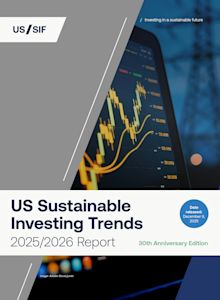
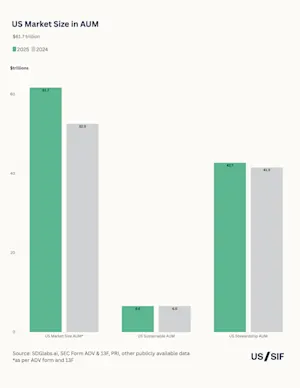
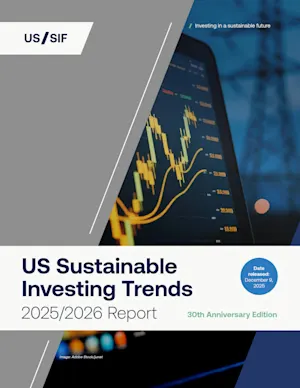
The US SIF Trends Report 2025/2026, celebrating its 30th year, delivers unparalleled insights into the rapidly evolving landscape of sustainable investing in the United States. As the premier source for data and analysis in the field, this report provides a comprehensive understanding of the trends driving $61.7 trillion in US assets under management (AUM), including $6.6 trillion explicitly marketed as ESG or sustainability-focused investments.
Methodology 2025/26
To learn more about the survey and the report, you can access our methodology
Download the US SIF Trends Report Infographics
Download every chart from the latest Trends Report to explore key insights in more detail.

Key Findings and Takeaways
Sustainable assets under management (AUM) and investor sentiment show resilience and optimism amid political headwinds. Importantly, sentiment across the industry remains optimistic: nearly 70% of respondents say they remain committed to sustainability’s long-term future.
$6.6trn
in Sustainable AUM
11%
identified or marketed as sustainable
69%
of the market covered by a stewardship policy
~70%
remained committed to sustainability
Sustainable AUM Trajectory Remained Stable
Despite political pressure, sustainable investing in the US remained steady through 2025. Sustainable assets rose slightly to $6.6 trillion, while the total market grew to $61.7 trillion, highlighting the scale of the broader financial system. Stewardship continues to anchor sustainable investing practices across the US. In 2025, 69% of total market AUM was covered by stewardship policies, reinforcing investors’ commitment to long-term value creation despite political scrutiny. Many firms are sharpening their focus on fiduciary duty, financial materiality and transparent engagement with companies. This shift reflects a maturing market in which sustainability considerations are increasingly integrated into mainstream investment practices.
The 2025 Survey in Context
The Importance of the US SIF Trends Survey
As we navigate the fast-changing landscape of sustainable investing, it is evident that the ability to triangulate findings through SEC ADV and 13F filings with the responses and perceptions from those in the sustainable investing trenches has become critical to ascertaining the real, evolving trends in the market.
The 2025 survey reflects a broad and senior cross-section of the sustainable investing community, with 270 institutions participating. Around 40% of respondents held high-level roles such as C-suite, principals, trustees and managing directors. This year, the US SIF Survey again asked respondents to share their own motivations and outlooks for the sustainable investing sector in addition to how their own firms were evolving in this quickly changing landscape.
The US Political Environment and its Perceived Impact on the Sustainable Investment Community
The shifting US political landscape has exerted a visible — though uneven — influence on investor attitudes and organizational strategies toward sustainability. Since 2023, heightened scrutiny of ESG investing has prompted investors to reassess terminology and practice. While some firms have refined their messaging, emphasizing fiduciary duty and financial materiality, others have continued with little or no change in strategy. The resulting environment is one of recalibration rather than retreat: investors remain committed to integrating sustainability considerations but are adapting language, stewardship protocols, and disclosure framing to align with evolving legal and political realities.
‘We have increased our education advocacy and speaking out’
‘We have aligned our external comms and language with executive orders’
'More scrutiny over public disclosures and speaking roles'
'Rewriting of core external materials and overall organizational mission'
'We take more precautions but our actions have not changed'

Key Findings
Growth Outlook
Individual sentiment toward sustainable investing remains positive overall, though expectations have tempered. In 2025, 53% expect moderate or strong growth in the coming year, compared with 73% in 2024. A noticeable shift is the increase in respondents anticipating a decline - 20% vs. just 3% last year - reflecting heightened political headwinds.
From the organizational perspective, growth expectations remain more stable. Most firms plan to maintain their sustainable investing allocations, while a third anticipate expanding them. Only a small minority expect any contraction.
Drivers of Sustainability
The primary drivers behind sustainability integration are firmly rooted in investment fundamentals. Respondents highlighted client demand, risk management and long-term returns as leading motivations—each increasing year-on-year. While delivering positive impact remains important, fewer respondents prioritised it compared with 2024, suggesting a shift toward a more financial-materiality-led narrative.
Market Responses
Communication practices around sustainability are evolving. Although nearly half of respondents made no changes, a growing number are adjusting their terminology to be more neutral—focusing on fiduciary duty, risk and value creation rather than politicised acronyms. Some firms have formalised updated definitions or policies that reinforce their long-term approach.
Alignment to Sustainable Development Goals
Overall Trend: Continued growth but uneven depth
Despite increased interest, structural challenges persist
Use of the UN Sustainable Development Goals continues to grow, with 50% of respondents incorporating them into their frameworks—up from 43% last year. Climate action, clean energy, economic growth, clean water and gender equality remain the top areas of focus. Many investors describe the SDGs as a practical guide for identifying opportunities and communicating investment aims, even if alignment varies in depth.
Use of Sustainable Investing Strategies
Implementation
ESG integration remains the dominant strategy, used by 77% of respondents. Many expect to increase their use of thematic and impact investing, while negative screening remains widely adopted. The overall pattern suggests a diversified mix of strategies that investors adjust depending on market context.
Negative Screening
Negative screening continues to play a central role. The most common exclusions—controversial weapons, tobacco/vaping and fossil fuels—remain largely unchanged from 2024. Although some firms expect to reduce screening slightly, the approach remains embedded in most sustainable investment processes.
Stewardship and Shareholder Advocacy
Stewardship activities remain core to investor practice but have moderated under increased scrutiny. Respondents reported declines in activities such as direct engagement, investor coalitions and public policy advocacy. Firms increasingly emphasise financial materiality and procedural rigour to ensure stewardship practices are defensible and aligned with regulatory expectations.
What Does the Future Hold?
Despite challenging conditions, respondents overwhelmingly express optimism about the future of sustainable investing. Nearly 70% remain hopeful and committed, often noting that sector dynamics are cyclical and likely to improve under future political leadership. Fewer than 5% view recent headwinds as a permanent setback.
Perspectives
Finally, the 2025 Survey asked a number of open-ended questions which we felt were important to get a deeper perspective on how US SIF and the sustainable investment sector may want to respond going forward.
We received over 100 responses to each question; the perspectives shared were personal and reflected the frustrations, challenges and a broad sense of being under attack, due to the increasing polarization and politicization of the work.
"Polarization makes it almost impossible to have thoughtful conversations."
To combat this, many responses included a call for:
"..deeper collaboration, partnerships and a coordinated response to strengthen advocacy, influence policy address and address misinformation."
On a more practical note, many responses highlighted the:
"..need for clear definitions and the standardization of disclosures.."
aligned with global standards. In conjunction with:
"..greater education and communication .."
to address misconceptions, build demand, and support informed decision-making.
The contradictions and lack of consensus within these particular section of survey responses highlight the pressing need for agreement by the industry on clear definitions, more knowledge and education, and increased collaboration.
US SIF continues to be at the center of these conversations and will address some of these challenges, in partnership with our members, through our upcoming quarterly roundtable series.

Get Involved
US SIF will be exploring these areas further in 2026 with a series of Chatham House roundtable discussions. If you would be interesting in participating and sharing your views please express your interest here.
Trends Sponsors



Explore the Trends Survey Analysis
To Explore the Full 2025/2026 Trends Survey Analysis, see the Full Report
Explore Last Year’s Report
Revisit the previous year’s insights and data in the full Trends Report.

Check out our previous reports
See the past 30 years of US SIF Sustainable Investing Trends in our resource center
Discover moreDiscover more